Machine Learning · Research
Motor Imagery Recognition (EEG)
Bachelor's thesis: a CNN-1D architecture for subject-independent motor-imagery classification from EEG signals, aimed at Brain-Computer Interfaces for assistive technologies.
Overview
My bachelor's thesis at the Universidade de Caxias do Sul tackled a Brain-Computer Interface (BCI) problem: recognizing motor imagery — the intention of movement — from raw EEG signals, in a way that generalizes across people. For users with severe paralysis, such a system can drive assistive devices through thought alone, so the classifier at its core is the hard, decisive component.
Approach
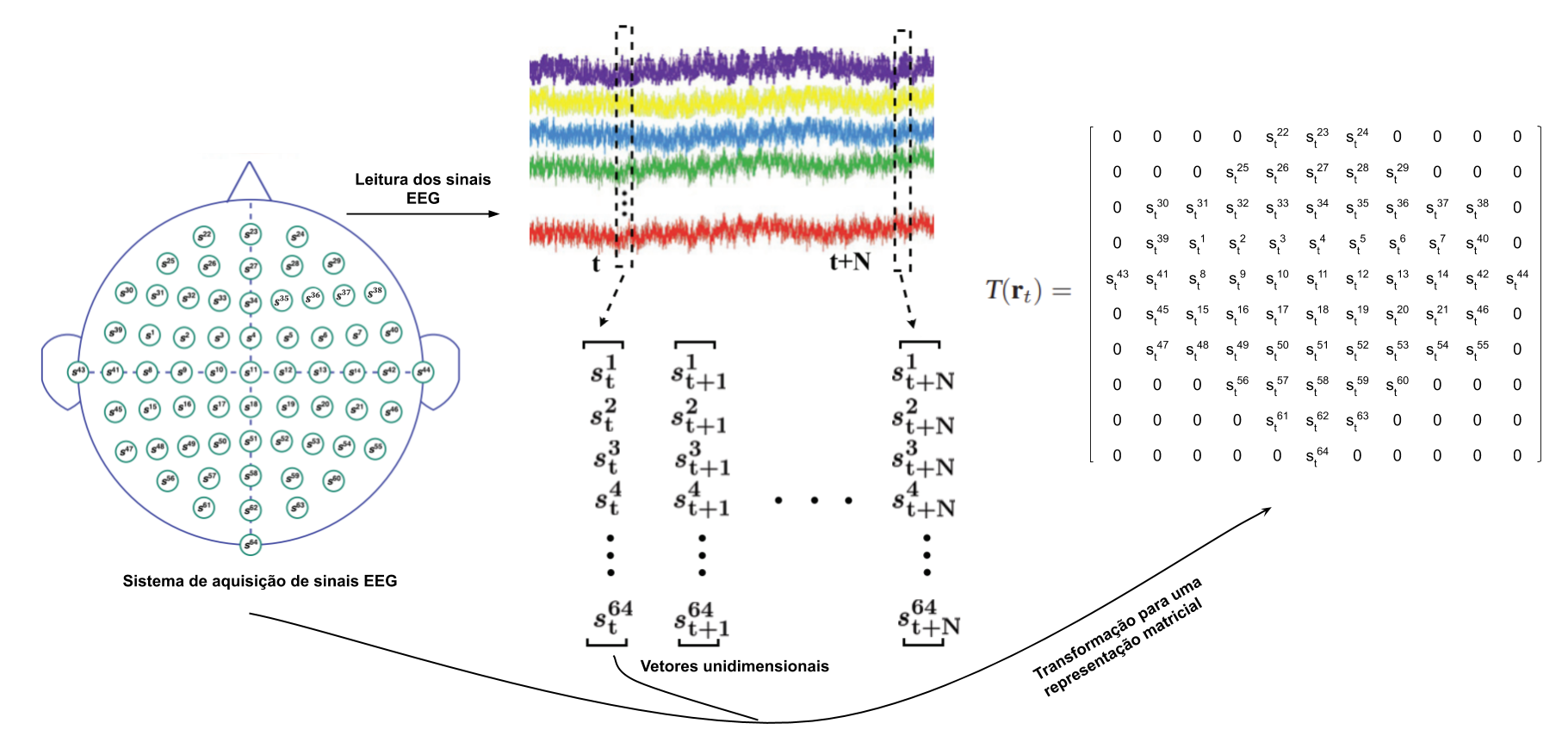
I started from a published CRNN baseline (Zhang et al., 2018) that used 2D convolutions over the spatial layout of EEG electrodes followed by LSTM layers for temporal features. Signals were normalized to reduce variability between subjects and sessions, targeting a subject-independent model, and everything was evaluated on the public PhysioNet dataset and two datasets from the IV BCI Competition.
Key contribution: a CNN-1D architecture
Two experiments reshaped the model into something simpler and stronger:
- Spatial information didn't help. Preserving electrode neighborhoods in a 2D input gave no measurable gain, so I dropped it and convolved over the temporal domain only.
- CNN beat LSTM for temporal features. With 3-second windows, temporal CNNs reached over 80% accuracy where the LSTM plateaued at 59–61% — so I replaced the recurrent layers entirely.
- Fewer parameters. Reduced feature maps and average pooling made the pure-CNN model lighter than the CRNN reference while performing as well or better.
Results
Subject-independent accuracy across datasets:
| Task | Dataset | Accuracy | Notes |
|---|---|---|---|
| Binary left fist · right fist | PhysioNet | 82.11% ± 3.65 | On par with the best in the literature (82.43%) |
| 4-class eyes closed · left fist · right fist · feet | PhysioNet | 66.11% ± 4.46 | +1.6% relative vs Wang et al. (2020) |
| Binary left hand · right hand | BCI Competition IV II-A | 78.31% ± 5.49 | +15.86% relative vs best feature-engineering approach |
| Binary left hand · right hand | BCI Competition IV II-B | 71.14% ± 5.63 | Subject-independent (leave-one-out) |
A secondary finding: subjects who received feedback during EEG acquisition showed an 11.19% relative accuracy improvement, suggesting feedback helps people modulate motor-imagery signals more clearly.
Outcome
The work is open source and has become my most-starred research — the motor-imagery and motor-imagery-deep-learning repositories together carry 30+ GitHub stars from others working on the same problem.